
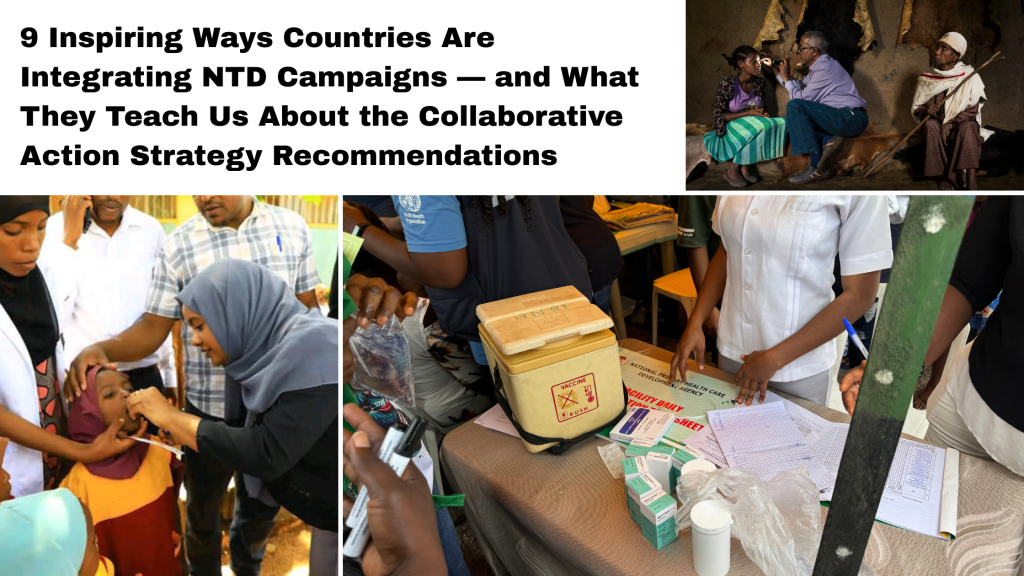
The Global Onchocerciasis Network for Elimination (GONE) webinar, hosted by WHO in July 2025, showcased powerful examples of how countries are integrating neglected tropical disease (NTD) efforts into broader health systems.
These experiences highlight the Health Campaign Effectiveness (HCE) Coalition’s Collaborative Action Strategy (CAS) in motion — showing how coordination, shared data, financing, and community engagement can make campaigns stronger, more efficient, and more sustainable.
Below, we explore nine country cases and the CAS recommendations each one brings to life and provide a brief summary and links to video segments and slides. Check out the full report for more details:

1. Benin: Engaging Communities Through Child Health Days
Benin has successfully integrated MDA for onchocerciasis (oncho), schistosomiasis (SCH) and soil-transmitted helminthiases (STH) into community and school-based platforms, improving coverage, sustainability and cost-efficiency—by 50% for oncho and by 75% for SCH and STH. It illustrates CAS recommendation 1e: Develop coordinated approaches for active community engagement, using trusted local platforms to boost participation.
2. Ethiopia: Embedding Integration Principles Across Health Campaigns
Ethiopia applied the CAS framework not only to NTD programs but also to other public health campaigns — from immunization to nutrition — promoting joint planning, shared supervision, and unified community engagement. By incorporating NTD activities into its primary health care system and aligning cross-program delivery, Ethiopia exemplifies CAS recommendation 1b: Identify campaigns and domains for collaboration and integration, demonstrating how integration can strengthen the entire campaign ecosystem.
3. Kenya: Driving Integration Through Digital Innovation
Kenya piloted a digital health campaign system for NTD mass-drug administration (MDA) that used mobile-phone data collection and integration with existing health-service delivery platforms, thereby improving efficiency and real-time monitoring. The digital integration also helped fold NTD campaign operations into the broader health information infrastructure rather than managing it as a parallel system. By harmonizing data and improving real-time monitoring, Kenya exemplifies CAS recommendation 2b: Improve ability to identify, measure, utilize, and share data on campaign effectiveness.
4. Madagascar: Planning Campaigns Together for Efficiency
Madagascar integrated lymphatic filariasis MDA with polio vaccination and vitamin A campaigns to enhance coverage and optimize resources. Initial standalone MDA expanded to integrated rounds across multiple districts, improving treatment reach and generating over USD 1.4 million in savings through shared logistics, supervision, and community mobilization. Later nationwide campaigns included schistosomiasis and soil-transmitted helminth control, achieving high coverage and operational efficiency. It’s a model of CAS recommendation 1c: Develop a multi-year, cross-campaign workplan and schedule, proving that synchronized planning can multiply impact.
5. Niger: Reaching Families Through Routine Outreach
Niger followed a similar model to Benin, integrating NTD treatments into ongoing child health outreach and extending services to remote and underserved communities. Niger’s integrated MDA approach, using unified teams with shared logistics and planning, has improved nationwide coverage and led to the elimination of onchocerciasis, control of lymphatic filariasis, and effective management of trachoma and intestinal worm infections. Niger’s experience also reflects CAS recommendation 1e: Active community engagement, showing how integration through existing outreach programs strengthens equitable access.
6. Rwanda: Building Stronger Coordination Across Sectors
Rwanda wove NTD interventions into its broader national health-system platforms, embedding prevention and control of NTDs within its primary health care and community health worker networks. The approach emphasizes multi-sectoral collaboration (education, water/sanitation, agriculture) and domestic ownership of NTD interventions to strengthen universal health-coverage goals. Rwanda’s integration efforts reflect CAS recommendation 1a: Establish or leverage an existing multi-sectoral, cross-campaign coordination body, showing the power of unified leadership and shared planning for health integration.
7. Tanzania: Sharing Tools and Logistics Across Programs
Tanzania integrated NTD MDA campaigns, combining treatments with nutrition interventions, including vitamin A supplementation, delivered through house-to-house and fixed-point approaches.This co-delivery model reduces duplication and strengthens linkages to the broader health-system infrastructure. This harmonization demonstrates CAS recommendation 1d: Harmonize tools and operations, reducing duplication and expanding reach.
8. Togo: Financing Sustainability from Within
Togo drew on a formal sustainability plan created in 2022 that pivoted NTD activities from vertical campaigns into mainstream health-systems and inter-sectoral platforms across endemic districts. In particular, Togo merged mass treatment for onchocerciasis, schistosomiasis and soil-transmitted helminths into integrated service delivery rather than isolated disease-by-disease efforts. Their experience illustrates CAS recommendation 3d: Advance government role in campaign financing, demonstrating how domestic ownership ensures integration lasts beyond donor cycles.
9. Uganda: Aligning Operations for System Strengthening
Uganda successfully integrated all case-management NTDs, into primary healthcare. MDA for preventive-chemotherapy NTDs was incorporated into Child Health Days, reaching children under 15 and pregnant women. This approach strengthened service delivery, improved coverage, and ensured that both treatment and preventive interventions were efficiently delivered through existing health platforms reflecting CAS recommendation 1d: Harmonize tools and operations, ensuring logistics, training, and microplanning are unified under one system.
Takeaway
Across these nine examples, countries are transforming health campaigns into collaborative, system-anchored efforts — aligning leadership, financing, data, and delivery for greater effectiveness. Early integration initiatives were driven by several NTD programs, reflecting their long-standing appreciation for the advantages of integrated approaches, even amid shifts in the donor landscape.
Each reflects the principles of the HCE Coalition and the recommendations of the Collaborative Action Strategy, proving that integration isn’t just efficient — it’s essential for stronger, more resilient health systems.
To support countries on this journey, the HCE Coalition developed a suite of practical resources known as CAS.tools. This package captures knowledge and tools generated through CAS recommendation implementation in Ethiopia and Nigeria, where governments opted in to pilot and refine the process.
Whether your country is just beginning to make campaigns more collaborative or building on earlier integration experiences, CAS tools provides adaptable materials to help design, customize, and operationalize CAS principles in your own context. You can also watch a walkthrough of the tools and explore the transcript and slides here.