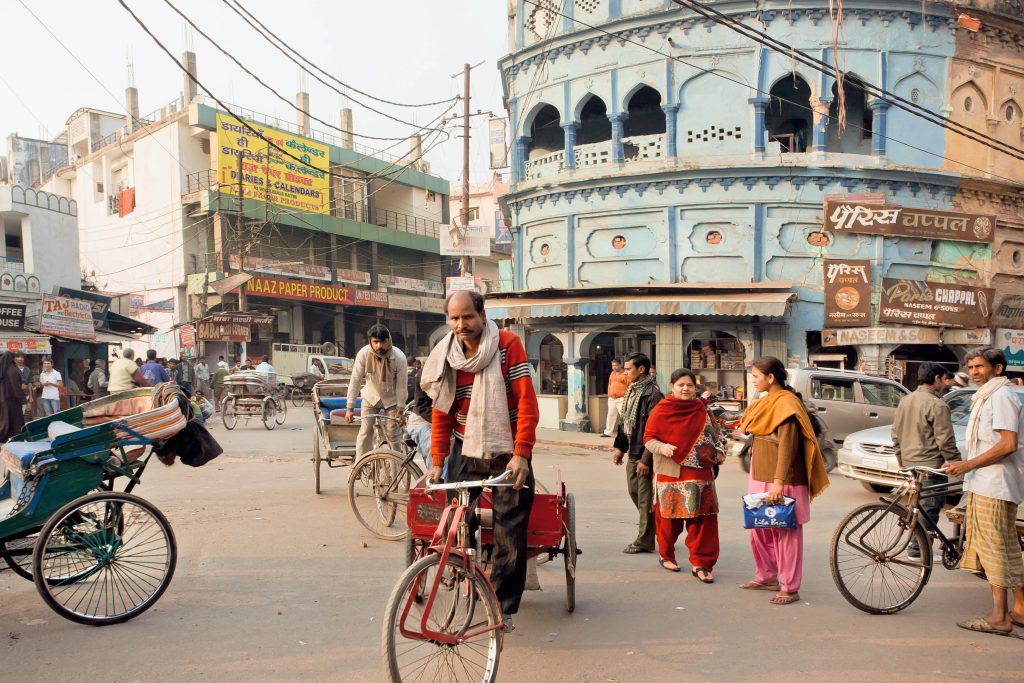
Photo in Uttar Pradesh, India. The state government of Uttar Pradesh supported this MDA integration study.
Health campaigns are commonly deployed strategies for tackling high-priority public health issues in India. Current and previously implemented campaigns in the country include immunization programs, mass drug administration (MDA) for soil-transmitted helminthiases (STH) and lymphatic filariasis (LF), and indoor residual spraying for visceral leishmaniasis (VL) and malaria. However, the COVID-19 pandemic has led to reduced field activities, deferring and cancelling planned campaigns. Integration of campaigns targeting the same population has become essential so multiple health interventions can be provided in a single visit.
For this study, PATH India explored collaborative planning approaches for integrating mass drug administration (MDA) campaigns for LF and STH, along with understanding how the learnings from India’s Pulse Polio immunization campaign could be effectively used to create a robust integrated campaign.
Context
Problems and Opportunities
LF and STH are serious public health problems in India; approximately 630 million people live in LF-endemic areas, and 241 million children are at risk of STH. LF elimination campaigns are underway in endemic areas of the country. MDA for STH is more diffused and is often integrated into existing services, such as school health activities. LF and STH MDA are candidates for integration because:
MDA campaigns for LF elimination include use of albendazole, which is also used to treat STH.
Beneficiaries of STH MDA (ages 1-19 years) overlap with LF MDA beneficiaries (>2 years of age).
COVID-19 has limited household visits for LF MDA, and interrupted STH MDA at schools; integration would streamline and facilitate delivery.
Integration would result in optimal utilization of drugs, logistics, and human resources; create synergy across program activities; increase cost-efficiency; and improve community outreach.
LF and STH campaign integration may be hindered by a lack of political will at the national and state level. The LF campaign is limited to endemic districts and only conducted once a year, whereas STH campaigns are conducted twice annually across all the districts, which may result in differing opinions between policy makers and program officers about the feasibility of integration. Furthermore, the COVID-19 pandemic and other emergencies may weaken prioritization of an integrated campaign.
Objectives
Identify enablers and barriers to operational efficiency and synergy for integrated delivery of MDA campaigns for LF and STH.
Utilize learnings from the Pulse Polio program to improve an integrated MDA campaign for LF and STH.
Create a uniform definition of integrated campaign implementation that would be acceptable to all stakeholders.
Integration of MDA campaigns for LF and STH, which use similar drug and distribution strategies, may increase coverage, reduce duplication of household visits, and optimize use of resources.