

Webinar recorded September 30, 2026
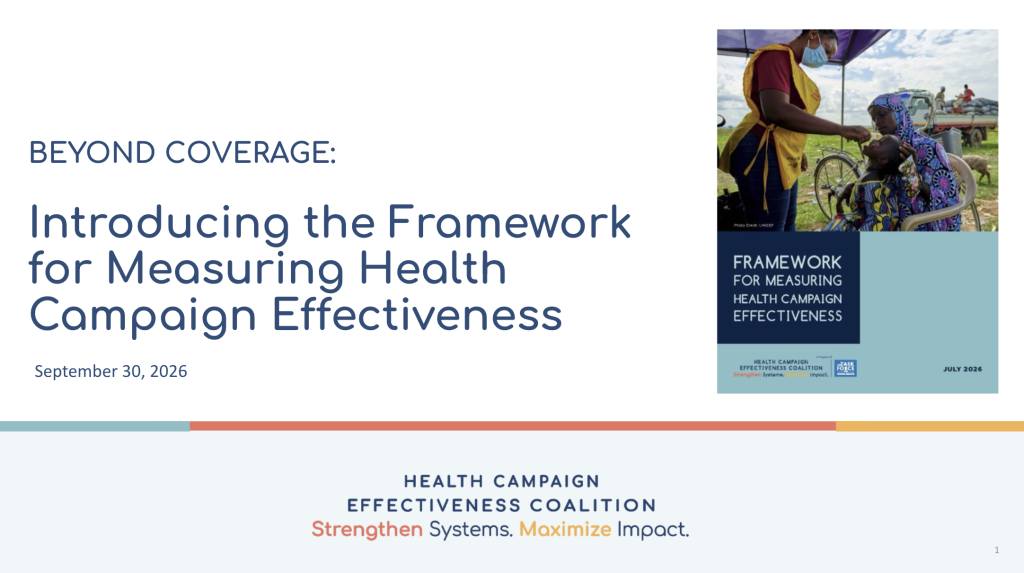
Coverage has long been the gold-standard indicator for health campaigns, but a single number can’t explain why people were missed or whether services were delivered efficiently, accessibly, and equitably. This webinar introduces the new Framework for Measuring Health Campaign Effectiveness, a practical tool to help countries and partners look beyond coverage and understand how well campaigns are really performing.
Dr. Andreas Hasman (Nutrition International, formerly UNICEF) and Carol McPhillips-Tangum (Task Force for Global Health) share lessons from country reviews of vitamin A supplementation programs in Mauritania and Sierra Leone, which examined 11 parameters of effectiveness alongside coverage. They then introduced the Framework and walked through its flexible five-step process.
The webinar also features a conversation with Dr. Stavia Turyahabwe, Commissioner for Communicable Disease Prevention and Control at Uganda’s Ministry of Health, moderated by Destiny Chukwu. Dr. Turyahabwe offers a country perspective on managing multiple, back-to-back campaigns, integrating campaign data into national platforms like DHIS2, and bringing community and caregiver voices into measurement.
What you’ll learn:
- Why coverage alone is not enough, and how access, acceptance, efficiency, and equity help explain gaps
- How the Framework’s five steps can be applied in your own context, whether campaign-based or integrated into routine services
- How to prioritize actionable indicators without overburdening staff
- Why country ownership, cross-program collaboration, and integration with routine systems are essential
Who should watch: Ministry of Health staff, immunization, nutrition, malaria, and NTD program managers, monitoring and evaluation specialists, and partners supporting health campaigns.
Speakers: Dr. Andreas Hasman (Nutrition International), Carol McPhillips-Tangum (Task Force for Global Health), Dr. Stavia Turyahabwe (Ministry of Health, Uganda), Destiny Chukwu (Task Force for Global Health), Kris Saarlas (Task Force for Global Health)
Watch the recording
English
French
Portuguese
Download the slides
Read the webinar summary
Presentation Summary
The presentation was delivered by Dr. Andreas Hasman (Nutrition International / former UNICEF) and Carol McPhillips-Tangum (Lead Author, Public Health Consultant):
- Moving “Beyond Coverage”: While coverage (the proportion of people receiving an intervention) has traditionally been the gold-standard indicator for campaigns, coverage alone compresses an entire system’s performance into a single number. It fails to explain why individuals were missed or whether services were delivered efficiently, accessibly, and equitably.
- Lessons from Country Reviews (Mauritania & Sierra Leone):
- Initial research evaluated Vitamin A supplementation programs—Mauritania using door-to-door campaigns and Sierra Leone using routine health system delivery.
- The study evaluated 11 parameters of effectiveness alongside coverage (e.g., access, service quality, equity, sustainability, resilience).
- Key Insight: Program effectiveness is highly contextual. For example, equity was prioritized more in Sierra Leone (where routine delivery yielded lower coverage) than in Mauritania (where campaigns reached people more equitably).
- The 5-Step Operational Framework: To translate these learnings into a practical tool for country ministries and partners, the new Framework for Measuring Health Campaign Effectiveness outlines a flexible 5-step process:
- Assess: Review current campaign goals, existing indicators, and available data sources.
- Identify: Determine what key performance questions remain unanswered by existing data.
- Select: Choose additional context-appropriate measures beyond basic coverage (such as acceptance, efficiency, or equity).
- Plan: Establish how data will be collected, leveraging and adapting existing routine systems where possible.
- Use: Apply data directly to improve real-time campaign delivery and future planning.
Highlights from Conversation with Dr. Stavia Turyahabwe of Ugandan Ministry of Health
The panel discussion featured Dr. Stavia Turyahawwe, Commissioner for Communicable Disease Prevention and Control at the Ministry of Health in Uganda, moderated by Destiny Chukwu:
- Real-World Country Context: Dr. Stavia highlighted the practical challenges of managing multiple, concurrent, or back-to-back health campaigns (e.g., malaria bed nets, polio, yellow fever, neglected tropical diseases) within national health systems.
- Data Integration & Routine Systems: She emphasized that campaign monitoring must not exist in an isolated “silo”. Effective measurement requires integrating campaign metrics into existing national platforms like DHIS2 so that data continues to inform primary healthcare beyond the campaign period.
- Community & Caregiver Voice: A major highlight was her focus on community engagement. Measuring “acceptance” and “access” requires understanding community perceptions, addressable hesitancy, and direct feedback from caregivers.
- Sustainability & Multi-Sector Coordination: Dr. Stavia stressed the importance of institutionalizing campaign evaluations within Ministry of Health governance structures to ensure continuous learning across different disease programs.
Key Takeaways Overall
- Coverage Is Not Enough: Coverage identifies if there is a gap, but broader parameters (access, acceptance, efficiency, equity) are needed to diagnose why gaps exist.
- Context Matters: What is feasible and essential to measure varies depending on whether delivery is campaign-based or integrated into routine healthcare.
- Action-Oriented Data: Measurement should focus on gathering actionable indicators that directly inform campaign mid-course corrections and future strategy, rather than overburdening staff with excessive data collection.
- Country Ownership: Successful measurement frameworks require local deliberation, cross-program collaboration (e.g., immunization, nutrition, NTDs), and institutionalizing feedback into routine systems.
See how the audience engaged
Participants engaged throughout via a live poll, Mentimeter exercises on where to look beyond coverage and where countries should start, and a Q&A on operationalizing the Framework and applying it in integrated campaigns.
In a live poll, every respondent reported measuring coverage in their last campaign, while far fewer measured equity (42%) or efficiency (23%), underscoring the gap the Framework aims to address.
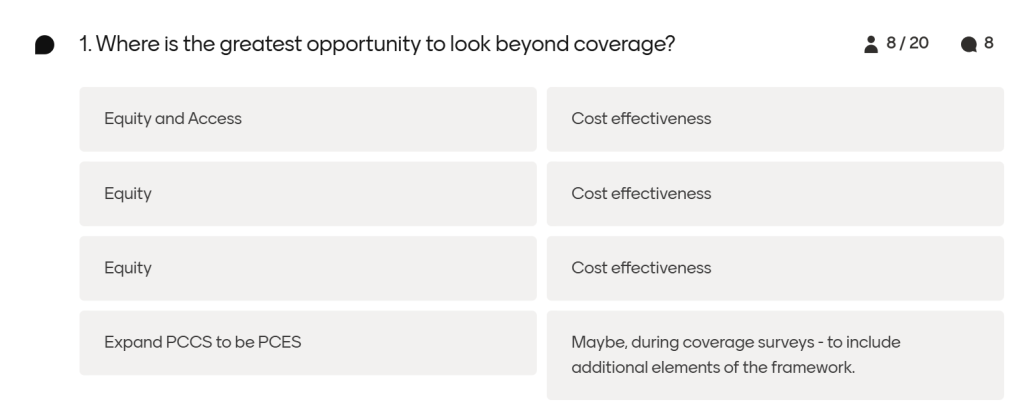
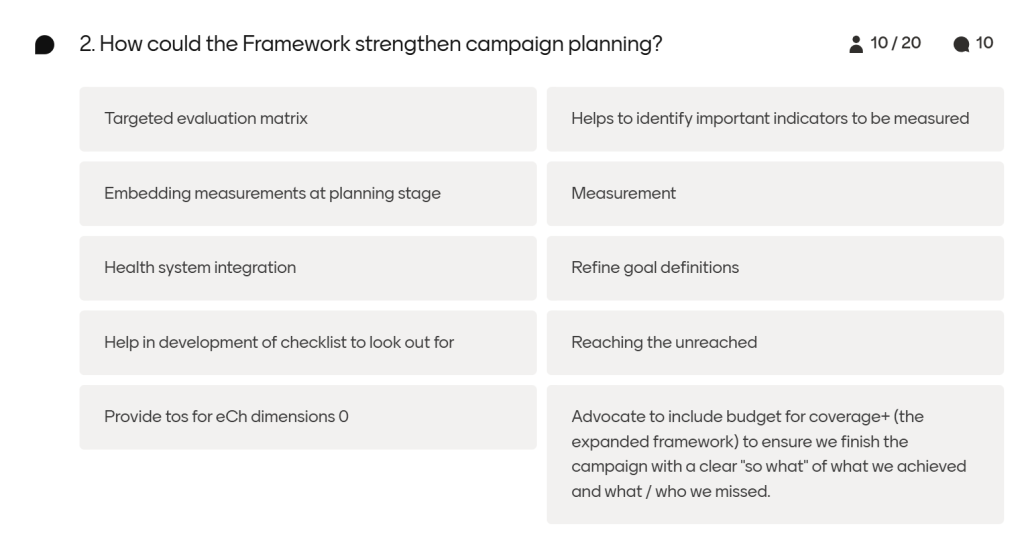

Mentimeter Exercise Responses
Audience Q&A
Q: Are you planning to issue country-level guidance on how to operationalize the expanded framework? Do you anticipate a role for HCE in supporting implementation, such as data collection or analysis, provided funding is available?
A: That’s an excellent question. We are currently exploring options for helping countries adopt and operationalize the Framework, and we would welcome hearing from countries about the assistance that would be most valuable to them.
Q: How feasible, efficient, and impactful will it be to conduct a campaign effectiveness assessment, especially for an intervention that integrates multiple health interventions and where focus group discussions and key informant interviews may be needed to identify existing barriers?
A: The experience in Mauritania and Sierra Leone shows that it is feasible to bring stakeholders together for meaningful, deliberate discussion about how to measure campaign effectiveness. Please feel free to follow up with us if you would like to discuss further.
For more information and to access a copy of the Framework for Measuring Health Campaign Effectiveness, click below.