

Picture this: within a few months, the same community is reached by a vaccination campaign, a deworming campaign, a bed net distribution campaign, and a health screening campaign—each with its own schedule, paperwork, budget, and reporting requirements. Communities experience repeated visits and disruptions, while frontline health workers repeatedly plan, staff, and report activities in the same locations. Yet many of these campaigns could share elements such as planning, logistics, supervision, data systems, or in appropriate settings, service delivery.
This is the everyday reality of health campaigns in much of the world, and it’s the problem the Collaborative Action Strategy (CAS) for Campaign Effectiveness was built to solve.

Why We Did This
For decades, large-scale health campaigns for immunization, malaria, neglected tropical diseases (NTDs), nutrition, and more have been essential tools for reaching people quickly with life-saving care. But they’ve also tended to run as separate, disease-specific operations. That fragmentation creates real costs: duplicated logistics, exhausted health workers, campaign fatigue in communities, and missed chances to strengthen the everyday health systems people rely on year-round.
The Health Campaign Effectiveness (HCE) Coalition developed the CAS to help countries identify where campaigns can coordinate or integrate planning, financing, logistics, data, supervision, and service delivery based on national priorities and the practical realities of each intervention. Between 2024 and early 2026, Ethiopia and Nigeria piloted the approach, testing different integration models spanning immunization, NTDs, malaria, nutrition, and selected noncommunicable disease services.
Our new evaluation report captures what happened when they did.
What We Learned
The honest answer is: a lot went right, and there’s still real work ahead.
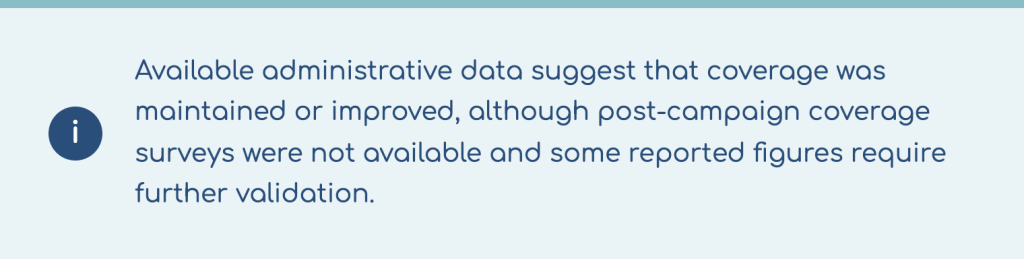
Integration is showing promising results, particularly in efficiency and reach. In Ethiopia, integrated delivery compressed approximately 25 days of standalone campaign work into a 10-day window, representing a reported 60% savings in project time. Integrated campaigns also identified and vaccinated more than 1.4 million zero-dose children. In Nigeria, preliminary estimates indicate that integrated measles-rubella and polio delivery generated more than $4.18 million in savings and reduced the delivery cost per vaccinated child by approximately 23%, from $0.30 to $0.23. And critically, none of this came at the expense of coverage. In several cases, coverage went up.
But integration isn’t all-or-nothing. In Ethiopia’s first pilot campaign, integration also showed up in coordination: shared scheduling, joint logistics, aligned supervision, not just co-delivery of interventions. Nigeria’s pilots showed a similar pattern: national teams pooled financing and built shared monitoring dashboards across programs, even as NTD and immunization teams in the field sometimes kept separate paces and documentation, given how differently their delivery models work. The question isn’t how far a country can push toward full integration, but which components make sense to integrate given the disease area, delivery strategy, and local context.
It’s not just an efficiency play, it strengthens health systems. When campaigns were deliberately connected to routine care, they became more than one-off events. In Ethiopia, referral protocols connected people identified with severe hypertension or cataracts to additional facility-based care. Both countries expanded the use of harmonized digital tools and dashboards for real-time monitoring, although paper-based and parallel reporting systems did not disappear entirely. Campaigns were less like isolated events and more like on-ramps into the regular health system.
Success requires country leadership, and country-specific design. Ethiopia and Nigeria both saw strong results because ministries of health championed integration from the top.National leadership was essential, but it was not sufficient on its own. In both countries, coordination and institutionalization remained varied at subnational levels. Neither country used a one-size-fits-all template. Nigeria tailored its approach state by state because a single model didn’t fit its diverse geography and disease burden. That flexibility was part of what made the pilots work.
Operational feasibility is only the beginning. Field teams demonstrated that integration can work, but they also encountered differences in campaign pace, documentation, workforce roles, and delivery models. Beyond these operational challenges, persistent structural barriers—including fragmented financing, uneven compensation, parallel data requirements, and incomplete subnational institutionalization—continue to constrain scale-up.
Global partners have work to do too. Ministries of health can’t solve fragmented financing on their own. Real, sustained scale-up will depend on funders and technical agencies moving past strategic endorsement toward actual structural change: pooling funding, simplifying technical requirements, and aligning funding cycles with the realities of integrated delivery.
What This Means for You
This report offers promising real-world evidence that country-led integration can improve efficiency, coordination, reach, and other dimensions of campaign effectiveness. It also provides a candid account of the operational and structural changes needed to sustain those gains.
The pilots provide a strong early proof of concept. Turning that momentum into lasting, system-wide practice will require sustained action across the health campaign ecosystem, not only from the countries leading implementation
Curious how it played out in Ethiopia and Nigeria, state by state and campaign by campaign? Read the full evaluation report to see the on-the-ground lessons and our recommendations for what comes next.
Explore what we learned
Click below to access the report and complementary country briefs.