Explore a curated set of the top 5 tools and templates with corresponding examples to begin planning more effective health campaigns right now.
Read More
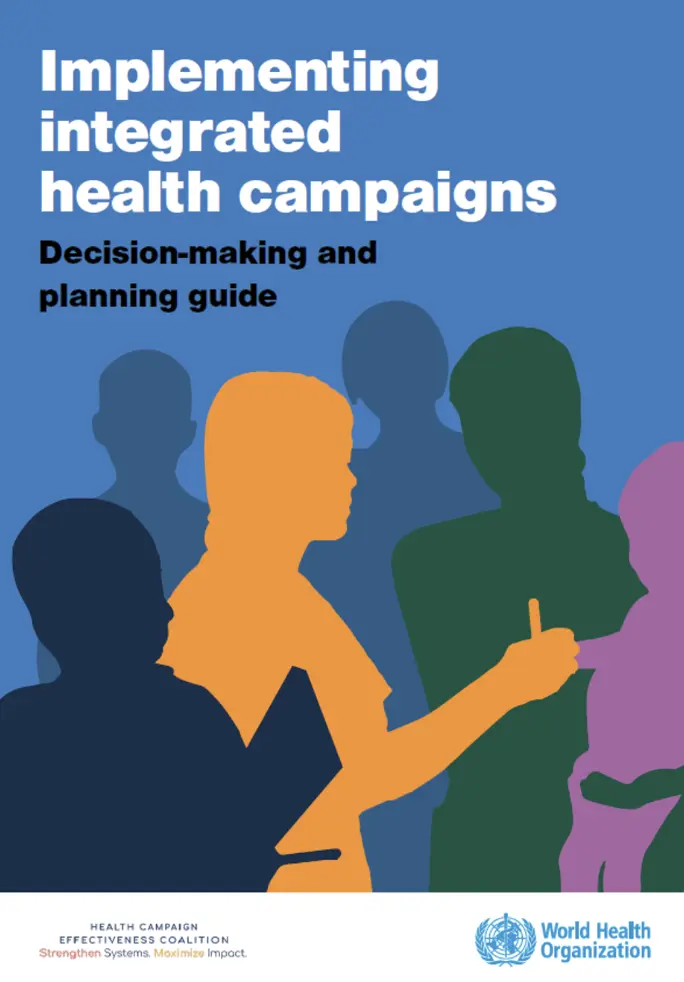
Before using the tools below, start by considering whether, where, and how health campaigns can be better coordinated or integrated in your country context. The World Health Organization and the HCE Coalition’s Implementing integrated health campaigns: Decision-making and planning guide provides a framework for making these decisions across health programs, helping countries identify opportunities to work together while considering the practical requirements and risks of integration.
The guide emphasizes that integration is not an end in itself, and that opportunities will vary depending on the campaigns, populations, geography, timing, delivery approaches, and health-system context. It provides a five-step process to help countries establish coordination mechanisms, map planned campaigns, assess opportunities for integration, develop a multi-year workplan and budget, and regularly review implementation plans. It also highlights the enabling conditions that need to be considered throughout the process—including governance, financing, workforce, logistics, communication, monitoring, safety, and post-campaign learning.
Guidance to help you get started
Before using the tools below, start by considering whether, where, and how health campaigns can be better coordinated or integrated in your country context. The World Health Organization and the HCE Coalition’s Implementing integrated health campaigns: Decision-making and planning guide provides a framework for making these decisions across health programs, helping countries identify opportunities to work together while considering the practical requirements and risks of integration.
The guide emphasizes that integration is not an end in itself, and that opportunities will vary depending on the campaigns, populations, geography, timing, delivery approaches, and health-system context. It provides a five-step process to help countries establish coordination mechanisms, map planned campaigns, assess opportunities for integration, develop a multi-year workplan and budget, and regularly review implementation plans. It also highlights the enabling conditions that need to be considered throughout the process—including governance, financing, workforce, logistics, communication, monitoring, safety, and post-campaign learning.
The tools on this page are designed to help put the this guide into practice. They support teams at different points in the planning process—from understanding what campaigns are already planned and who needs to be involved, to establishing coordination structures and translating integration decisions into operational plans and procedures. Each tool is accompanied, where available, by country examples showing how countries have adapted and applied these approaches in practice.
Together, the guidance, tools, templates, and country examples provide a practical starting point for countries looking to move from understanding opportunities for collaboration to planning and implementing more coordinated and integrated campaigns.
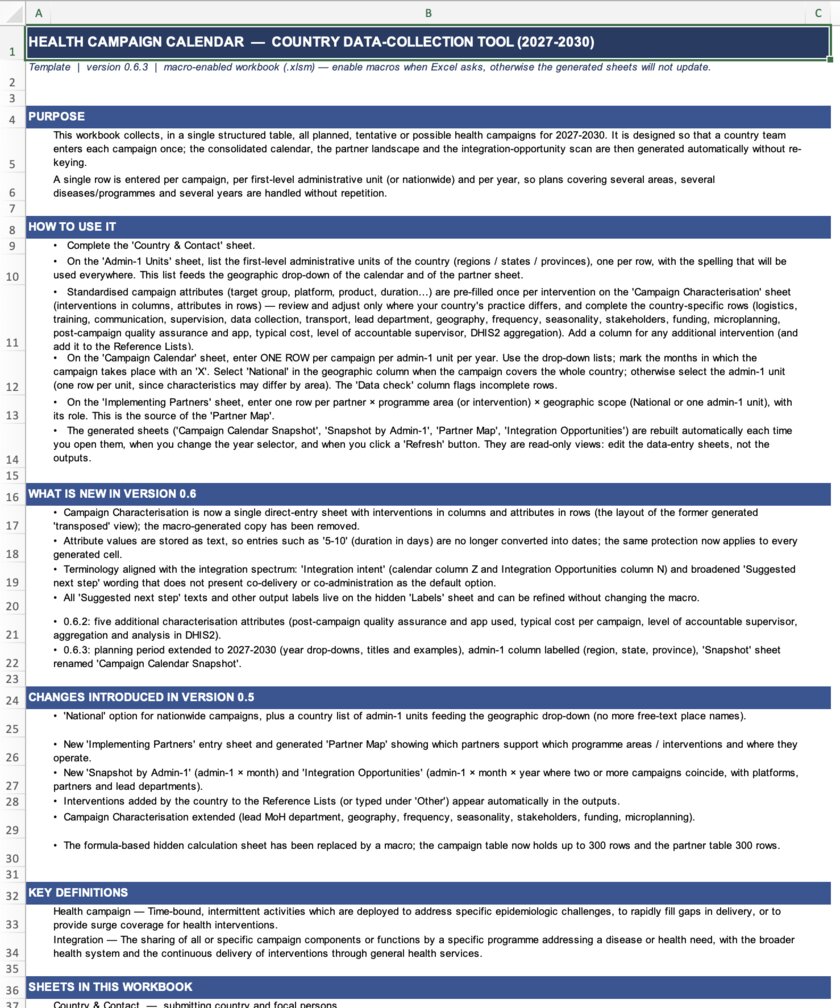
One of the quickest and easiest ways to start collaborating on campaigns is to create a shared campaign calendar. Work with your colleagues in other programs to find out what campaigns they are planning and when those campaigns are taking place. Use this tool to compile campaign schedules, intervention characteristics, and partner support across programs and geographic areas. The tool offers automated calendars, partner maps, and overlap summaries to help country teams identify opportunities for coordinated scheduling, shared campaign functions, and integrated delivery. Excel-based. Originally developed through CAS focus-country work, with the campaign calendar developed by Nigeria and the campaign characterization approach first applied in Ethiopia, and subsequently adapted by WHO AFRO for broader use.
Shows how campaign characterization can assess compatibility across programs. Ethiopia compared campaign characteristics including target populations, geography, timing, delivery approaches, logistics, workforce, supervision, and data systems to identify common practices, harmonization opportunities, and potential co-delivery options across immunization, malaria, NTDs, nutrition, and NCD screening.
Shows how a consolidated cross-program campaign calendar can identify and prioritize integration opportunities. Nigeria combined campaign schedules across programs, then assessed geographic and timing overlap, political and partner readiness, target populations, and delivery approaches to identify feasible opportunities for coordinated planning and integrated delivery across priority states.
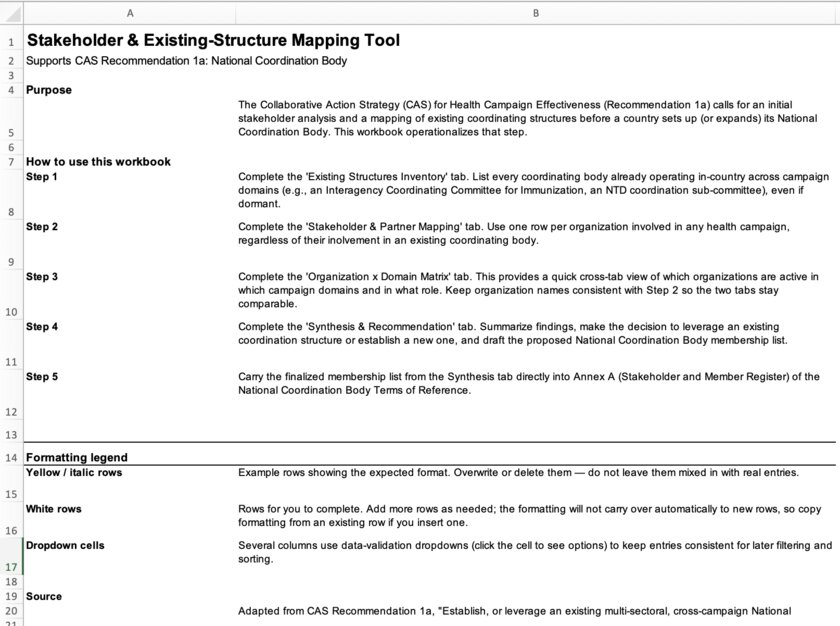
An Excel-based tool for mapping campaign stakeholders and existing coordination structures. Country teams can document organizational roles, identify representation and coordination gaps, and assess whether to expand an existing body or establish a new National Coordination Body.
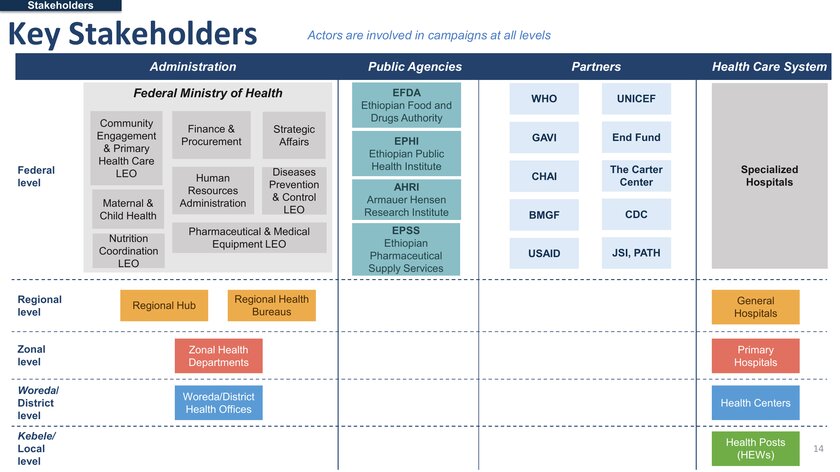
Stakeholder and existing structure mapping from Ethiopia’s CAS feasibility assessment. The diagrams organize government bodies, public agencies, partners, health services, technical working groups, and committees by administrative level, supporting country discussions on which actors and structures to involve in campaign coordination.
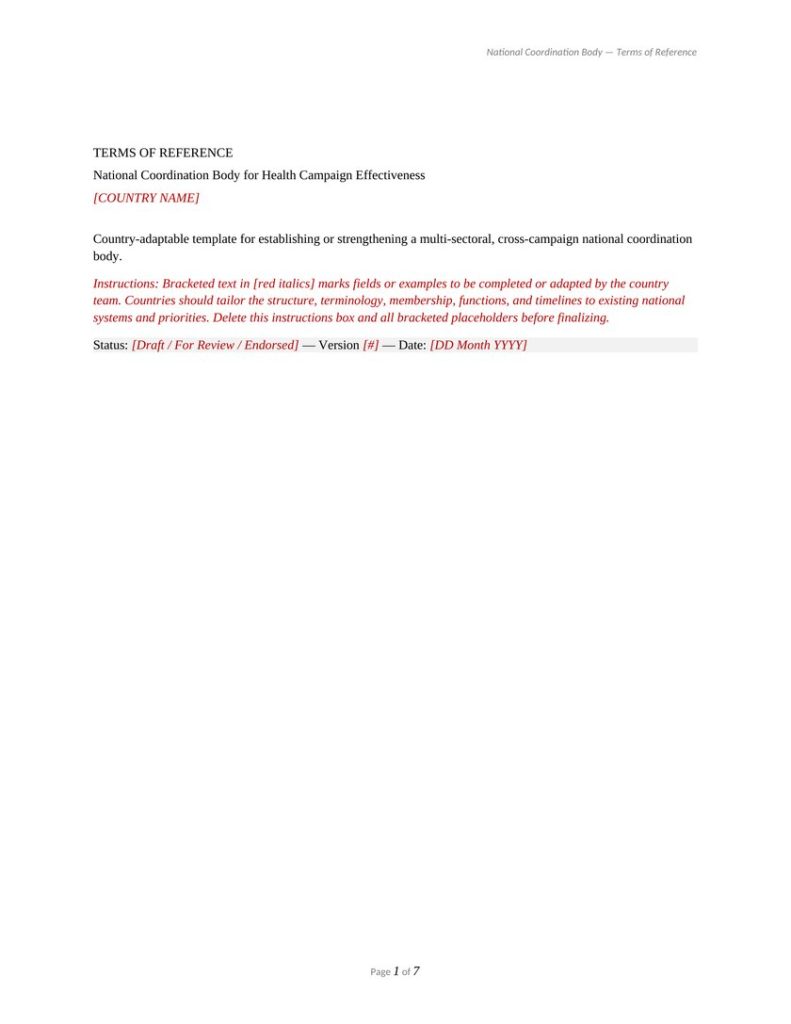
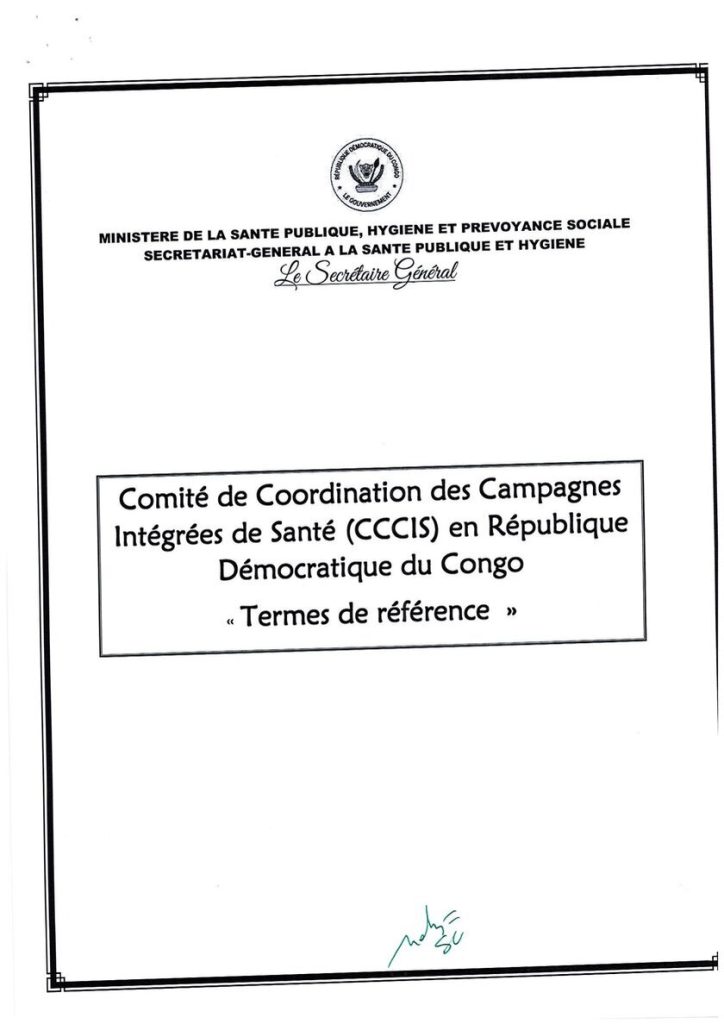
A template for defining the purpose, membership, responsibilities, and operating arrangements of a National Coordination Body for health campaigns. Country teams can adapt provisions on technical working groups, decision-making, reporting, and secretariat support to strengthen coordination across campaign programs.
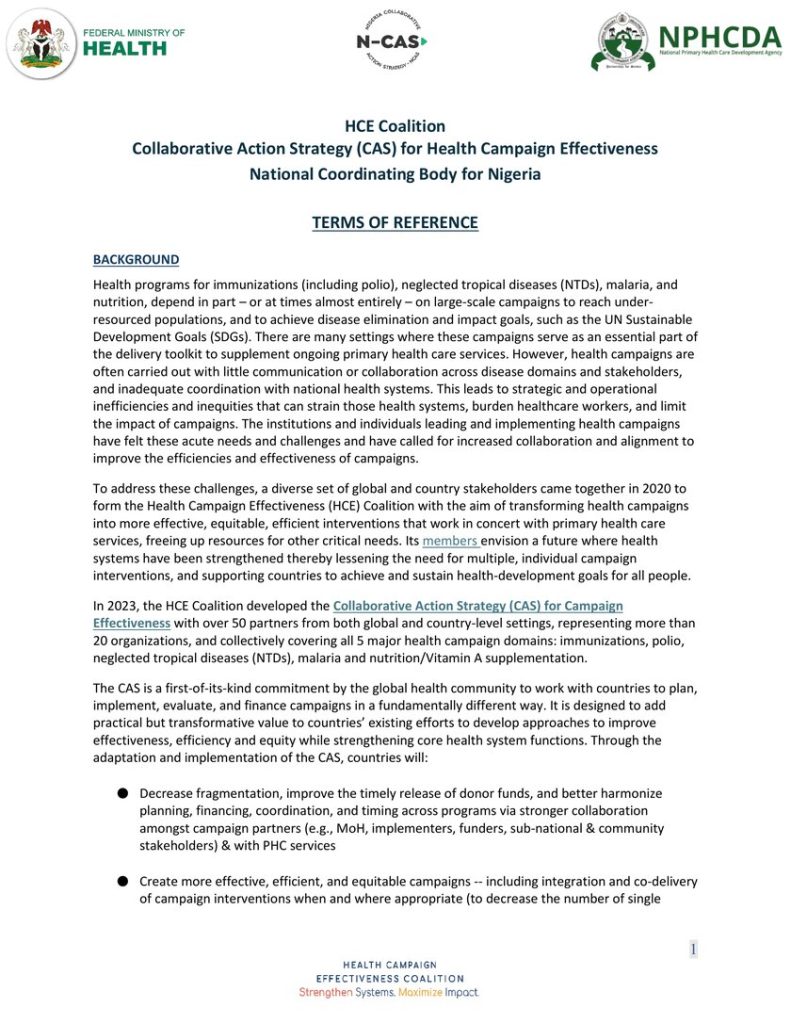
Nigeria - National Coordinating Body Terms of Reference
The document outlines the body’s purpose, membership, leadership, responsibilities, and decision-making arrangements for overseeing Collaborative Action Strategy implementation, providing a reference for countries developing or adapting their own terms of reference.
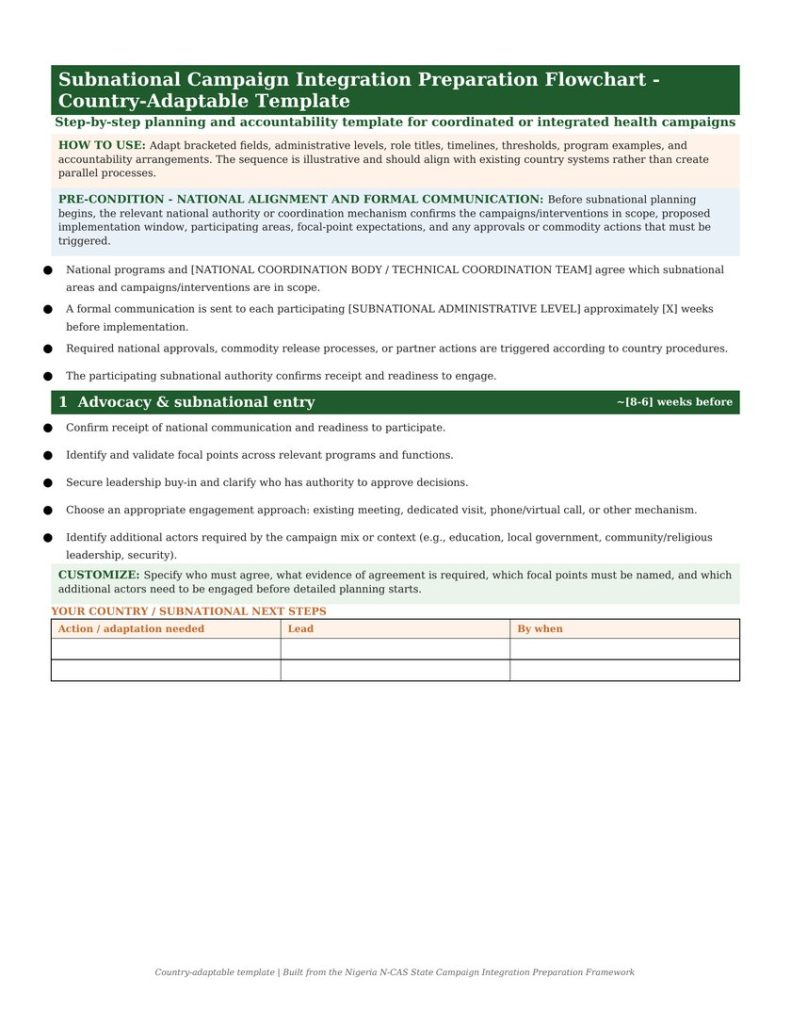
A customizable template adapted from Nigeria’s state-level campaign integration flowchart to help countries operationalize coordinated and integrated campaigns at subnational levels. The template guides teams through advocacy, microplanning, readiness, implementation, post-campaign learning, and accountability, while allowing timelines, roles, thresholds, terminology, and operational requirements to be tailored to context and priorities.
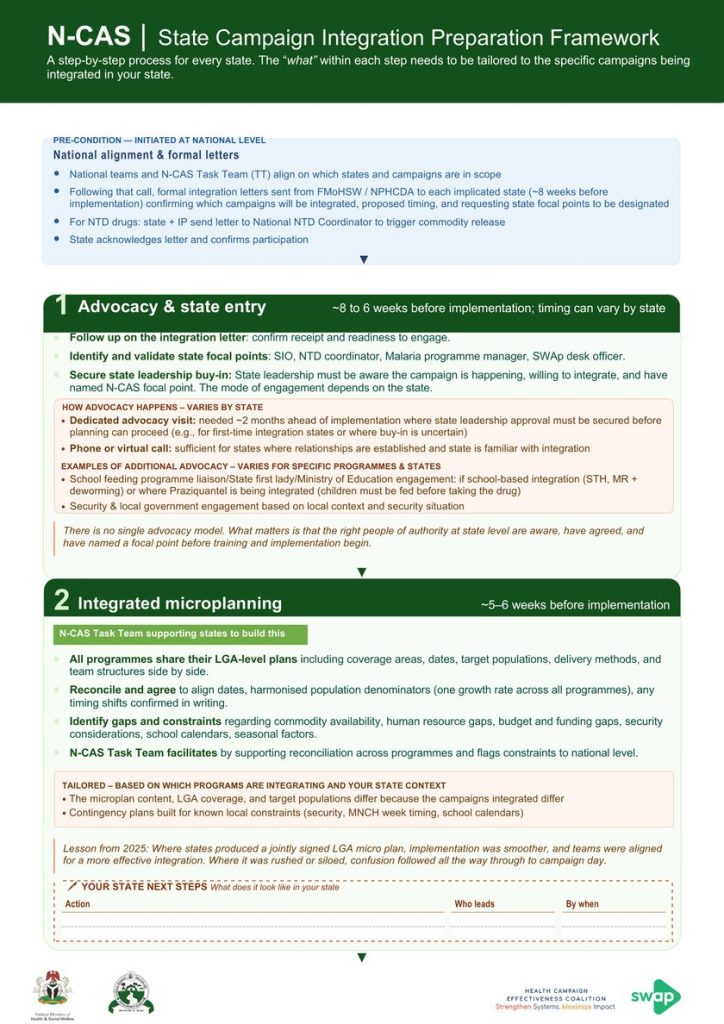
A flowchart showing Nigeria’s steps for preparing, implementing, and reviewing integrated health campaigns at state level. The flowchart includes indicative timelines, readiness checks, and action tables, alongside a State and Partner Commitments Charter for documenting responsibilities, funding commitments, and follow-up.
N-CAS country example showing how a state-level flowchart translates national integration decisions into a time-bound operational sequence for states. The flowchart guides advocacy and entry, integrated microplanning, readiness checks, implementation, and post-campaign review, while defining minimum standards that can be tailored to each state, campaign mix, and local context realities.
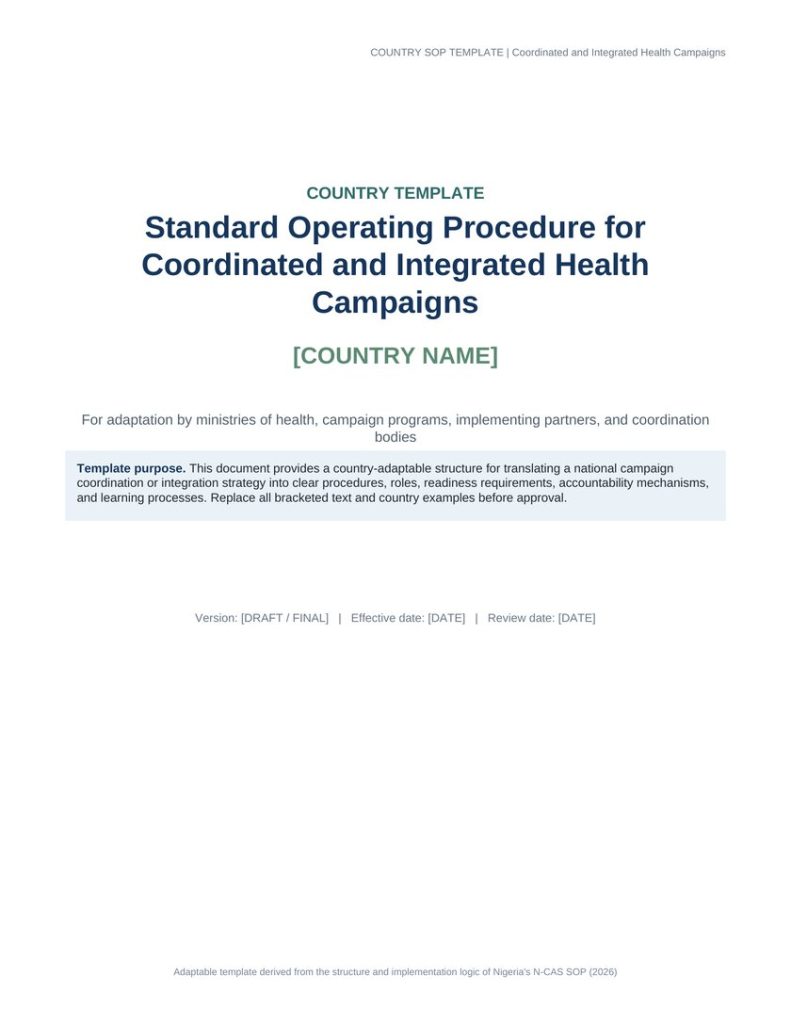
5. Standard Operating Procedure for Coordinated and Integrated Health Campaigns
A customizable standard operating procedure (SOP) template building on Nigeria’s N-CAS example to help countries translate campaign integration strategies into clear operating procedures. The template guides users to define governance, roles, annual planning cycles, readiness requirements, implementation procedures, accountability mechanisms, performance indicators, and learning processes, while adapting each section to national contexts appropriately.
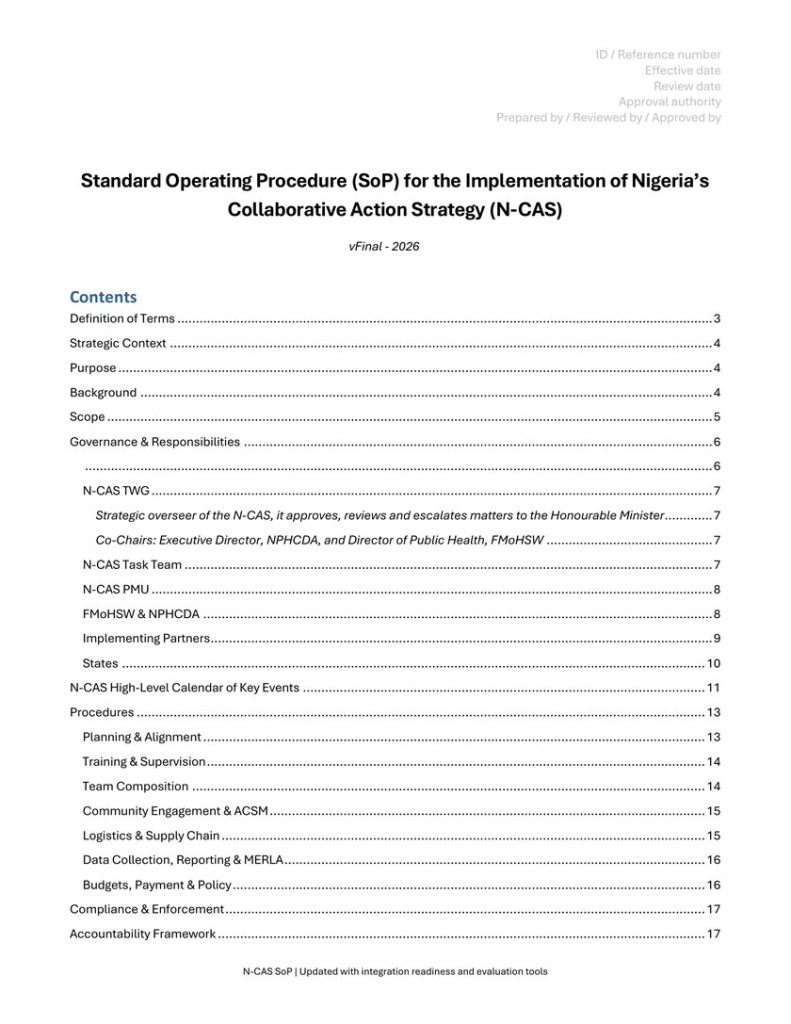
Nigeria - Collaborative Action Strategy Standard Operating Procedure
A country example detailing standard procedures for implementing Nigeria’s Collaborative Action Strategy. The procedures cover campaign planning, training, logistics, community engagement, financing, data, and review, supported by responsibility assignments, integration readiness and evaluation checklists, and accountability arrangements across national, state, and local levels.
Have a question or need help using a tool? Contact our team at campaigneffectiveness@taskforce.org. Stay up to date on new tools, templates, and examples by signing up for our newsletter. And tell us what would help your work most: we welcome your ideas for new tools and would love to feature your story using HCE Coalition tools and approaches.
Related Content
About the Collaborative Action Strategy
Learn about the Collaborative Action Strategy for Health Campaign Effectiveness, including how it was piloted in Ethiopia and Nigeria and what the evaluation found.
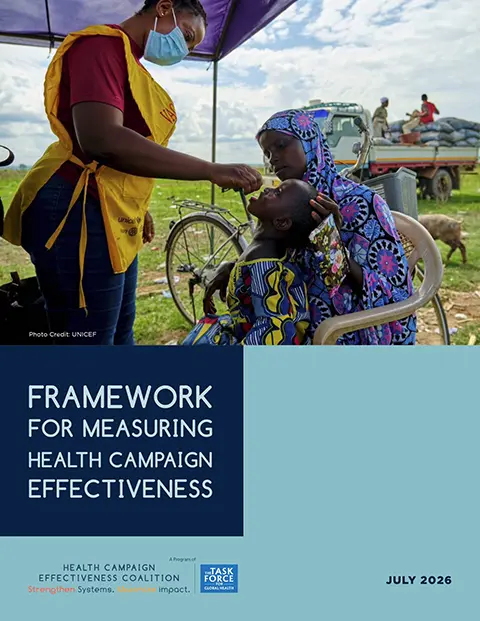
Framework for Measuring Health Campaign Effectiveness
A practical, user-friendly guide for Ministries of Health and partners to take a broader approach to measuring the effectiveness of health campaigns—one that measures acceptance, access, efficiency, and equity alongside coverage.
A step-by-step guide with tools, templates, and examples for putting each recommendation of the Collaborative Action Strategy for Health Campaign Effectiveness into practice.